

David CairnsThe Baron of Finavon

The Much Honoured Baron of Finavon (David Charles Cairns of Finavon, Baron of Finavon)
spouse Victoria Lady Finavon
heir Samantha The Maid of Finavon
Credentials
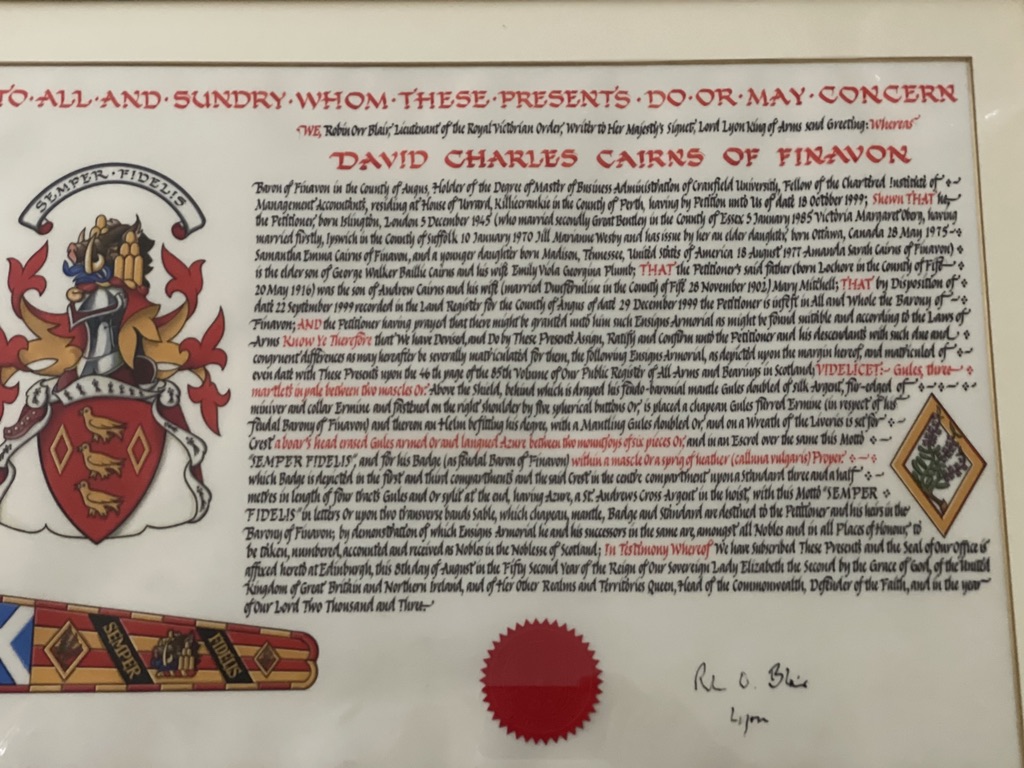
- • Verified by The Roll 27 Mar 2026 seeing original Letters Patent "Baron of Finavon in the County of Angus " officially recognised by Lord Lyon King of Arms 8th August 2003
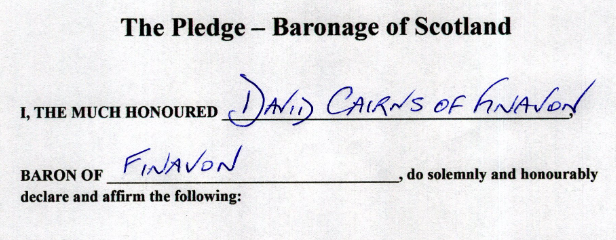
- • PLEDGED HEREDITARY TITLE, this label indicates that the holder has formally signed the Roll’s Baronial Pledge — a non-legal declaration of intent that the barony be preserved within the family line and treated as a hereditary dignity. The Pledge operates as a family compact, intended to be retained with the holder’s will and estate papers. In accordance with Roll policy, the title becomes unrecognised by the Roll if the barony is later conveyed outside the family.
- • Lady Victoria Cairns, the Lady of Finavon:
- • ladyoffinavon.com/in-the-studio
- • cairnsoffinavon.com/the-author
Authentication
A note on terminology: “Scottish feudal barony” or “feudal title” is an incorrect, defunct historical term for extant barons. Baronies were feudal until 28 November 2004, when feudal baronies were abolished and the dignity of baron was retained — an extant barony is no longer “feudal”. The correct term is Scottish barony or Scottish baron (or baron, lord or earl in the Baronage of Scotland, collectively the minor barons of Scotland); never “feudal baron”. Why the term is defunct →
A barony pledged on the Roll of Scottish Barons is treated by the Roll as hereditary and not in commercio. A pledged barony later conveyed outside the family forfeits its recognition on the Roll in perpetuity. What “Hereditary on the Roll” means →