

Edward RutledgeLord Coupar
Baron of Coupar

The Much Honoured Lord Coupar OStJ FSAScot (Edward Kirby Rutledge, 14th Lord Baron of Coupar in the baronage of Scotland)
spouse Katherine Lady Coupar
Elizabeth The Maid of Coupar
hereditary bailie Eleanor Rutledge
Credentials
- • Burke's Peerage Revised Families. Burke's Peerage (Genealogical Books) Ltd. Updated 2026 "Lord and Baron of the Regality of Coupar" burkespeerage.com/search.php
- • NOT A REGALITY: Held in regality by the abbots (Rental Book of Cupar-Angus, i, pp. xxxv, 117); reserved to the Crown when erected a lordship and barony in 1606 (RPS, 1605/6/118). rps.ac.uk/trans/1605/6/118
- • Scottish Barony Register, Dignity of the Barony of Coupar (County of Perth) 1st Feb 2024 Vol 6 Folio 1
- • Crown charters created a Lordship and Barony — RMS 1593–1608, no. 2002 (20 Dec 1607) and RMS 1609–1620, no. 1956 (24 Dec 1618) the original RMS charters clearly mention both barony and lordship, and grant styling as “Lord Coupar.” According to Lord Clyde’s dictum in Spencer-Thomas v. Newell (1992), the omission of words like “barony” or “lordship” in later deeds does not deprive a dignity of its status if originally established and not lawfully extinguished. This styling coincided with the simultaneous elevation as a Lord of Parliament, a peerage dignity which was later forfeited and is no longer transmissible. The dignity that remains — that is, the Lordship and Barony of Coupar — was historically a feudal and territorial honour, but under the Abolition of Feudal Tenure etc. (Scotland) Act 2000, it is now recognised as a non-territorial, incorporeal heritable dignity, preserved by law but no longer attached to land or feudalism.
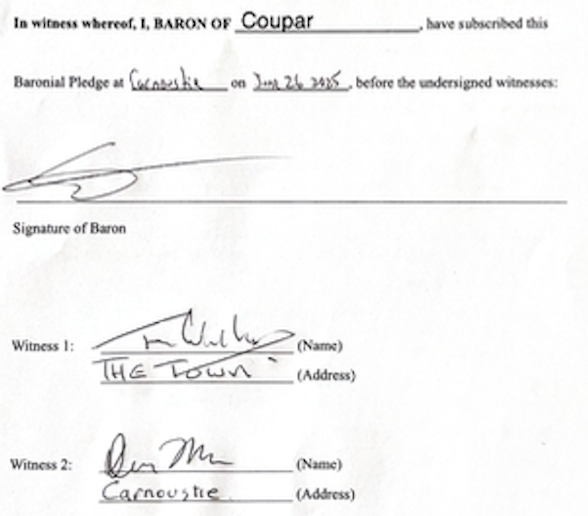
- • PLEDGED HEREDITARY TITLE, this label indicates that the holder has formally signed the Roll’s Baronial Pledge — a non-legal declaration of intent that the barony be preserved within the family line and treated as a hereditary dignity. The Pledge operates as a family compact, intended to be retained with the holder’s will and estate papers. In accordance with Roll policy, the title becomes unrecognised by the Roll if the barony is later conveyed outside the family
Authentication
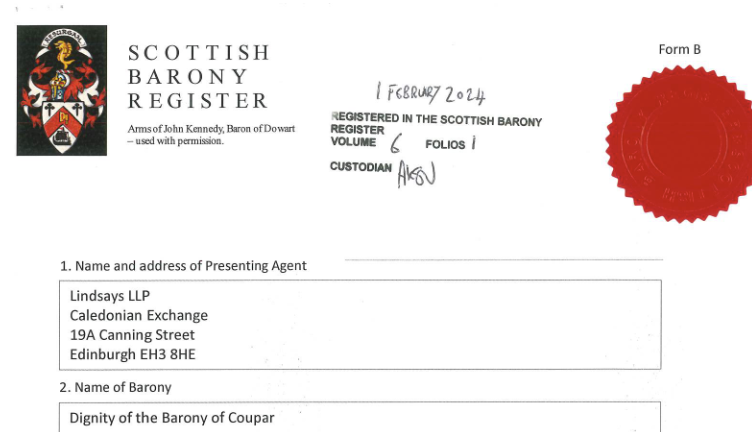
A note on terminology: “Scottish feudal barony” or “feudal title” is an incorrect, defunct historical term for extant barons. Baronies were feudal until 28 November 2004, when feudal baronies were abolished and the dignity of baron was retained — an extant barony is no longer “feudal”. The correct term is Scottish barony or Scottish baron (or baron, lord or earl in the Baronage of Scotland, collectively the minor barons of Scotland); never “feudal baron”. Why the term is defunct →
A barony pledged on the Roll of Scottish Barons is treated by the Roll as hereditary and not in commercio. A pledged barony later conveyed outside the family forfeits its recognition on the Roll in perpetuity. What “Hereditary on the Roll” means →