
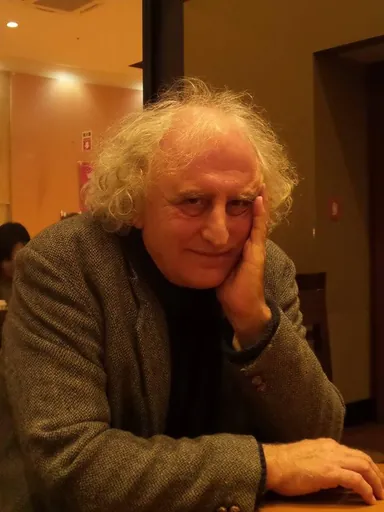
John Oliphant of RossieRepresenter of the Baronial House of Rossie
Clan Chieftain

Representer of the Baronial House of Oliphant of Rossie (John Oliphant of Rossie, Chieftain of Clan Oliphant of Rossie)
Credentials
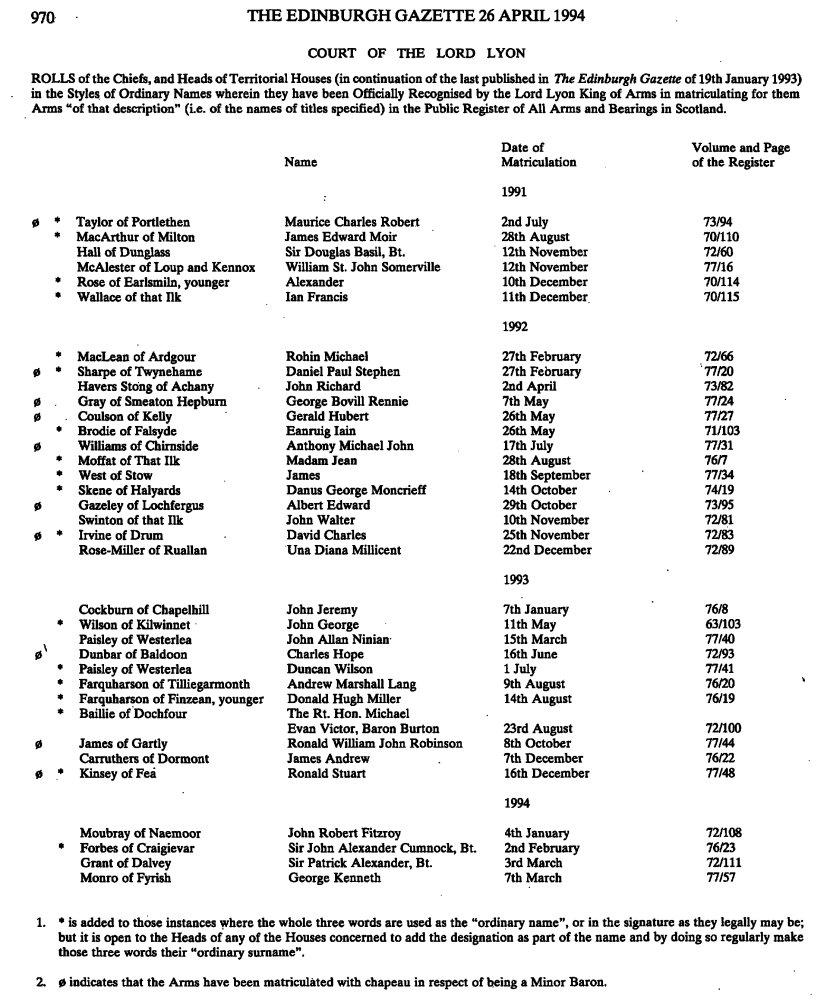
- • Lord Lyon recognised John Oliphant of Rossie as Representer of the Baronial House of Oliphant of Rossie, matriculating arms with a blue chapeau at LO 78/6 on 6 April 1994. The blue chapeau marks the representer of a baronial family no longer in possession of the barony. It is not recognition as Baron of Rossie. The family is Oliphant of Rossie Ochil in the parish of Forgandenny, Perthshire (family papers, National Records of Scotland, GD1/391, 1470–1911); the seat appears in the Crown records only as a place, "Ochiell-Rossy" (Register of the Great Seal, RMS, vol. iv, no. 329). No Oliphant is retoured in a barony of Rossie to 1700, and the baronies of that name in the records were others’: Rossie in Strathearn, erected on 26 June 1621 for Sir Andrew Rollo of Duncrub "in liberam baroniam de Rossie, ordinando manerium de R. principale fore messuagium" (RMS viii, no. 183; archive.org/…/n67); Rossie in Fife (Scott of Rossie, Great Seal charter of 21 October 1639, ratified RPS 1641/8/444; Brown of Fordell, Retours, Fife, no. 891, 1661); and Rossie in Forfar (Rossy of that Ilk, RMS ii, no. 1610, 1484). What the Oliphants bought from James Bonar of Rossie in 1613 was half the west end of Forgandenny, the Charterhouse lands, not Rossie (RMS vii, no. 907, 6 August 1613). The barony held by the house’s own stock was Forgound, erected on 23 January 1630 for Sir James Oliphant of Newton, baronet, son of Sir William Oliphant of Newton, King’s Advocate: "rex omnia suprascripta incorporavit in unam liberam baroniam de Forgound, ordinando turrim de F. principale fore messuagium", with a burgh of barony, expressly distinct from the old barony of Forgandenny (RMS viii, no. 1513; archive.org/…/n515), apprised on 25 July 1632 to John Oliphant of Bachilton (RMS viii, no. 2044); Newton of Forgandenny lay "infra baroniam de Forgundeny" (Retours, Perth, no. 863, 8 May 1674). Which barony the Lord Lyon’s recognition of 1994 rests on is not shown by these records.
- • Rolls of the Chiefs and Heads of Territorial Houses, Officially-Recognised by Lord Lyon King of Arms 6th April 1994 (LXXVIII 6), EDINBURGH GAZETTE
Authentication
A note on terminology: “Scottish feudal barony” or “feudal title” is an incorrect, defunct historical term for extant barons. Baronies were feudal until 28 November 2004, when feudal baronies were abolished and the dignity of baron was retained — an extant barony is no longer “feudal”. The correct term is Scottish barony or Scottish baron (or baron, lord or earl in the Baronage of Scotland, collectively the minor barons of Scotland); never “feudal baron”. Why the term is defunct →
A barony pledged on the Roll of Scottish Barons is treated by the Roll as hereditary and not in commercio. A pledged barony later conveyed outside the family forfeits its recognition on the Roll in perpetuity. What “Hereditary on the Roll” means →